
Third Book
Unscripted: The Extraordinary Journey of Kamala Harris
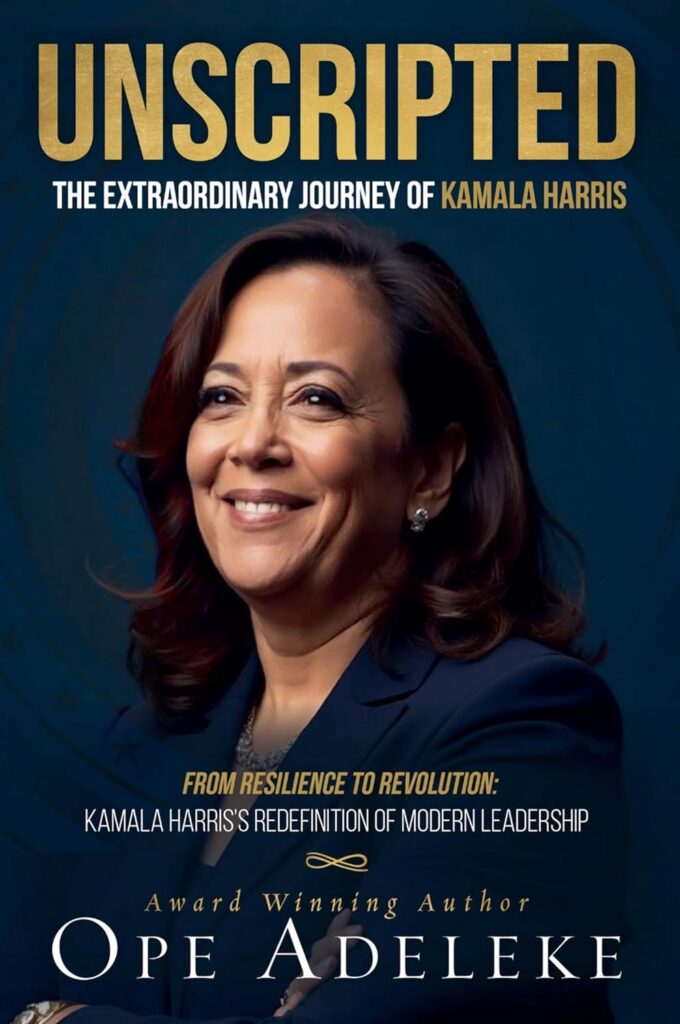

UNSCRIPTED: THE EXTRAORDINARY JOURNEY OF KAMALA HARRIS unveils the remarkable story of one of the most transformative figures in contemporary politics. This biography captures Kamala Harris’s evolution from a resilient advocate for justice to a revolutionary leader redefining modern leadership.
From Resilience to Revolution, explore the layers of Harris’s extraordinary journey as she navigates personal trials, professional milestones, and societal shifts. Through a captivating narrative, discover how her unwavering commitment to equity and justice has reshaped the contours of leadership.
Delve into the book to uncover:
Pivotal Moments: Detailed accounts of key events that propelled Harris from her roots to national prominence.
Leadership Redefined: Insight into how Harris has challenged conventional norms, blending empathy, courage, and innovation to lead effectively.
Personal Triumphs and Challenges: Intimate revelations of the obstacles she faced and overcame, illustrating her indomitable spirit and resilience.
Cultural and Societal Impact: An examination of Harris’s influence on contemporary issues, and how her vision is driving change on a global scale.
Rich in personal anecdotes and sharp analysis, UNSCRIPTED provides a profound look at Kamala Harris’s transformative impact on leadership and legacy. This book is essential reading for anyone interested in the evolution of leadership, the power of resilience, and the dynamics of modern politics.
Discover the journey of a leader who not only envisioned a better future but also forged the path to make it a reality.
Unscripted: The Extraordinary Journey of Kamala Harris
Kamala Harris’s Jamaican and Indian heritage, instilled by her parents Donald and Shyamala, deeply influenced her identity, values, and outlook on life, fostering a unique blend of resilience, justice, and cultural pride that guided her from childhood through her formative years. Her experiences at Howard University and UC Hastings College of Law, combined with pivotal moments in her early legal career, solidified her commitment to reforming the justice system and advocating for equality, ultimately propelling her to become a trailblazing leader in American politics.
Kamala Harris’s early leadership and passion for activism were evident during her high school years in Montreal, where she and her sister successfully protested to allow children to play soccer on their apartment lawn, reflecting her innate commitment to justice. At Howard University, the empowering environment of an HBCU and her involvement with Alpha Kappa Alpha Sorority deepened her dedication to social justice and leadership, which she carried into law school at UC Hastings, preparing her for a career devoted to systemic change and public service.
During her tenure as Attorney General of California from 2011 to 2017, Kamala Harris implemented significant reforms in criminal justice, consumer protection, and civil rights, notably securing an $18.4 billion settlement for homeowners affected by the foreclosure crisis and advancing privacy rights legislation. Despite facing criticisms over her handling of wrongful convictions and the complexities of balancing progressive ideals with the duties of a state’s top law enforcement officer, she left a lasting impact on California’s legal system through initiatives aimed at reducing recidivism and promoting equality.
Kamala Harris’s historic election as the first Black woman from California to serve in the U.S. Senate marked a pivotal moment in her career, where she became a prominent figure on the Judiciary, Intelligence, and Homeland Security committees—gaining national attention for her sharp questioning during high-profile hearings and her unwavering commitment to justice and equality. Throughout her Senate tenure, she vigorously advocated for healthcare reform, immigration rights, criminal justice reform, economic justice, and environmental justice, laying the groundwork for her subsequent presidential campaign and eventual selection as Vice President.
Kamala Harris launched her 2020 presidential campaign on Martin Luther King Jr. Day, aligning her message with ideals of justice and equality, and quickly gained momentum with powerful speeches and a standout debate performance where she confronted Joe Biden on racial issues. Despite early success, her campaign struggled with shifting policy positions, particularly on healthcare, financial difficulties, and internal organizational challenges, leading her to suspend her bid but ultimately positioning herself as a key supporter of Biden and paving the way for her future role as Vice President.
Kamala Harris was selected as Joe Biden’s running mate in the 2020 presidential election after a rigorous vetting process, where her experience, diversity, and ability to connect with voters made her the standout choice. Together, they campaigned on unity and competence, leading to their election victory, which was historic not only for defeating an incumbent but also for Harris becoming the first woman and person of color to serve as Vice President, symbolizing a significant step forward for representation in American politics.
Kamala Harris’s first year as Vice President was defined by historic expectations and significant challenges, as she navigated her groundbreaking role while tackling complex issues such as addressing the root causes of Central American migration and leading national voting rights efforts—tasks that faced substantial obstacles and intensified media scrutiny, including internal staff discord that impacted public perception of her leadership. Despite these hurdles, she played a pivotal role in legislative achievements like the American Rescue Plan and the Infrastructure Investment and Jobs Act, actively contributed to the administration’s COVID-19 response by promoting equitable vaccine distribution, and engaged in international diplomacy on climate change and public health, demonstrating a steadfast commitment to progressive change amid a tumultuous political landscape.